
Take a Risk with Words
We have the power to present others a reality that is in our minds, to come up to the world in a unique perspective, rather for the mere sense of exchanging meanings with others, or to the world betterment.
We call poetics when we use some language that, in a sense, belongs to a narrative form of being appreciative and is leaning to infuse some good perceptions about others and the world around us. This appreciative perspective is tackled through inquiry to show what gives life, even in the most challenging circumstances. Going to the core, appreciating what it is now.
Then stories, images, poems and other forms of expression have a place in playful minds, creating representations of what can be something universal into something concrete. Always looking at what different perspectives can be brought into place and what new lenses it can provide us to look through.
Language is not a mirror of reality but creates reality since reality is constructed from a collective perspective of shared meanings. We can not take for granted any so-called an absolute truth; there is always something behind to look for.
No assumptions can be made when we speak about what reality is, on a collective, as every perspective brings assumptions to an edge.
“We need to stay aware of the Images and voices of hope.”
– D. Zandee.

SUMMARY
The poetics of Organizational Design: How Words May Inspire Worlds
Danielle P. Zandee
In this article, the author references the power of words and meaning in the worlds we create around them. It specifies the prevalence of the perspectives brought to the field of organizations. She states that we give meaning to our lived experience through the narrative mode of knowing. “We discover what might be possible in organizational life through embellished, contextual stories about particular, concrete events.” (Tsoukas & Hatch, 2001, p. 983).
Zandee gives reference to a poetic understanding of our lived experiences. Therefore, in appreciative inquiry the narrative mode is prevalent during the phase of diverging conversations where it makes deliberate, extensive use of the so-called “poetic language” (Cunliffe, 2002) in its positive form.
We can see here the use of Storytelling making an appearance as a “pivotal element of any appreciative inquiry initiative -appreciative storytelling or -provocative propositions, which are statements that describe some aspects of the desired organization.” (Strati, 2000, p. 13). “Thus, organizational aesthetics concerns itself with knowing through the perceptive faculties of hearing, sight, touch, smell and taste, and by the capacity for aesthetic judgment” (Strati, 1999, p. 2).
Also Zandee refers to the unmanaged organizations where “emotions prevail over rationality and pleasure over reality” (p. 477). Stating that this is an space that escapes the “logico-rational attention of managerial control”, and brings someplace to “storytelling and other poetic accounts of captivating organizational experiences.”
Furthermore, the article approaches Appreciative inquiry as a new form of “inquiry as art” as a metaphor to open the mind into the complex aspects of organizational life (Cooperrider, 1990, 1996; Cooperrider & Barrett, 2002; Cooperrider & Srivastva, 1987; Zandee & Cooperrider, 2008).
These resultant stories are “mined to locate actionable themes (Watkins & Mohr, 2001), and metaphor is introduced as a tool to expand participants’ thinking.”
Meanwhile, these good stories are shared, “evocative images arise in the interaction between teller and listener”. For that reason, the author states that “poetic language is imaginative”. It is “about images/imagining rather than literal meaning, about creating possibilities rather than describing actualities” (Cunliffe, 2002, p. 133).
The awakeness of the senses while reading a good poeam or story reach us to our human position, and to each other, this empathy brings generativity into the narrative inquiry, as it becomes a holistic and imaginative way of getting closer to the complexity of emotions and characteristics of being human indeed.
“Organizational environments that are designed for aesthetic, tactile appeal may help us feel more at home and authentically present in spontaneous interactions. Imaginative, ambiguous, touching, and holistic – that are poetic, rather than just pragmatic, in nature.” Zandee.
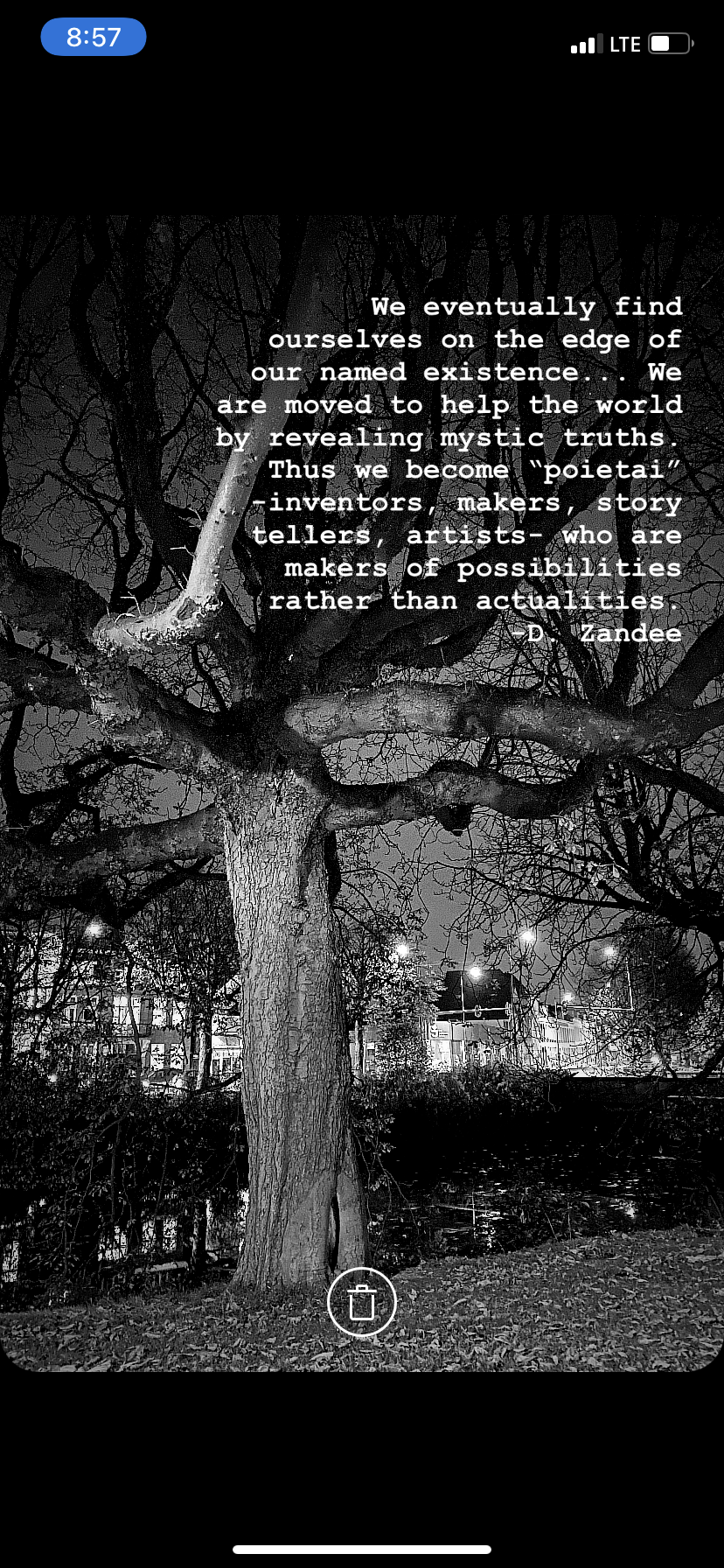
Group Assignment During Lecture - Sharing inspirational Stories
The Four Lenses
When we see the other as "a vital co-creator of our mind, our self, and our society" Sampson, 1993.
We can see our surroundings through 4 different lenses;
- Appreciative: Exploring the Vital Core, What gives life. Reframing problems.
- Discursive: Stories come to life to give meaning.
- Artful: Expressing the unknown through imagination. Novelty.
- Relational: Part of a whole, UBUNTU. Creating valuable customer experiences.

SUMMARY
DESIGNING FOR POSITIVE OUTCOMES: USING POSITIVE
MEMES, DISTRIBUTIVE EMPOWERMENT, OPEN SOURCE
DEVELOPMENT, AND POSITIVE METAPHORS
Julie E. Kendall and Kenneth E. Kendall

In this work the authors provided a framework of four approaches for influencing the use and adoption of information systems in a positive way.
The four approaches are:
1. introducing positive memes,
2. empowering decision making through the sharing of positive information,
3. encouraging open source development and positive improvement, and
4. embracing positive metaphors.
INTRODUCING POSITIVE MEMES. Memes are a potent tool. A meme, a concept created by Dawkins (1976), “is simply any idea that make its way into minds and which can be transferred from one mind to another. One example of a meme is a memory aid”. Humans are vulnerable to banal memes such as rhymes, catchy tunes or phrases, funny images, etc. Metaphors are induced here as a meme in the way they are figures of speech that function to say that one thing is another.
“Metaphors shape the way people behave, thus they are powerful evocations of reality. While metaphors are useful in facilitating conceptualizations of organizational life, Hirschheim and Newman (1991), Kaarst-Brown and Robey (1999), and Kendall and Kendall (1993) have all explored metaphors in the context of information systems users, developers, and IT managers.”
Furthermore, their intention is to point out that a change in an organization may implicate different things such as changing procedures or the structure of the organization itself. “Lyytinen and Robey (1999) point to the difficulties of organizations learning positive practices and also recommend ways to overcome organizational myths that perpetuate systems development failure.
To sum up, the positive outcome of a challenge in an organization demands a positive attitude. We can discover an organizational subculture by helping them share the meaning of a positive methapor, identifying it, and embracing it. This way, this metaphor will serve for a much greater likelihood of success.